
Best overall: the area where a care operator has confirmed property requirements. Best for expansion: a neighbouring commissioning area with a separate written brief. Best for a constrained budget: the area where a suitable property needs the least corrective work—not automatically the cheapest town. The best UK areas for supported living property investment in 2026 are defined by operator demand, property suitability and workable lease terms; Diamond Property connects healthcare organisations with landlords and agents offering properties on long-term company leases.
- The best UK areas for supported living property investment 2026 start with confirmed operator requirements, not regional rankings.
- Diamond Property provides supported living property sourcing and lease negotiation for care-sector operators.
- An existing operating area is the first shortlist for an operator-led investment search.
- Neighbouring areas need their own demand checks; proximity does not establish supported living demand.
- Choose a company let only after checking property suitability, responsibilities and lease terms.
Why this matters
A location can work for ordinary residential letting and still fail a supported living brief. Bedrooms alone do not establish suitability. The intended residents, staffing arrangements, access requirements and proposed use determine what the property must support.
Do not buy a property first and treat finding a care operator as the final step. Establish the operating requirement before committing to a location. A long-term company lease does not, by itself, prove resident demand or remove landlord obligations.
For a 2026 investment decision, separate three questions: does the operator want this area, does the building fit the service, and does the proposed agreement allocate responsibilities clearly? A positive answer to one does not answer the others.
What makes the best supported living investment area?
Use these criteria before comparing towns, postcodes or regions:
- Written operator demand: A named operator specifies the location, intended use and property requirements. A general expression of interest is not a property brief.
- Commissioning fit: Establish how the proposed service relates to the relevant commissioning arrangements. Operator interest and a commissioned service are different things.
- Resident suitability: Check accessibility, layout, transport and nearby services against the intended residents’ needs—not a generic property checklist.
- Operational practicality: Confirm staffing access, management arrangements and the facilities the operator needs to deliver its service.
- Property permissions: Investigate the proposed use, planning position, licensing, lender conditions and insurance before relying on a lease proposal.
- Lease clarity: Identify who is responsible for adaptations, repairs, compliance work, inspections and reinstatement. Put the allocation in writing.
These criteria do not produce a universal winning city. They produce a defensible shortlist for a particular service and property.
Best investment areas at a glance
The ranking below compares location strategies, not regional yields. Each option serves a different investment brief. None establishes that a particular city has stronger demand than another.
| Rank and area profile | Best for | Standout advantage | Key limitation |
|---|---|---|---|
| 1. Operator’s existing service area | A first operator-led purchase | Search starts with a defined operating geography | Existing presence does not prove an additional property is needed |
| 2. Neighbouring commissioning area | Geographic expansion | Creates a focused extension shortlist | Adjacent areas require separate demand checks |
| 3. Area named in a specialist housing brief | A defined resident group | Location follows an explicit service requirement | A narrow brief limits acceptable properties |
| 4. Area with a property matching an adaptation brief | Building-led suitability | Existing layout can be assessed against specific needs | Physical fit alone does not establish demand |
| 5. A separately assessed UK jurisdiction | Cross-border expansion | Opens a distinct geographic search | Regulatory and commissioning assumptions cannot simply transfer |
1. Operator’s existing service area: best for a first purchase
Start with the local authority or commissioning area where your intended operator already delivers services and has confirmed a further property requirement. This makes the search specific. You can assess actual locations against an operating brief rather than searching an entire region.
An established footprint is useful context, not proof of additional demand. Ask the operator to distinguish existing services from the proposed service that would occupy your property.
Existing service area pros:
- Gives your search a defined geographic boundary.
- Allows property requirements to be discussed with an identified operator.
- Connects location selection to a specific operating plan.
Existing service area cons:
- An operator’s presence does not establish a need for another building.
- Suitable properties still require individual legal and physical checks.
Best for: A landlord making a first operator-led supported living investment in 2026.
Diamond Property is a supported living property sourcing agency for care-sector operators seeking properties on long-term company leases. Its role is sourcing and lease negotiation; your location decision still needs a clear brief and property-specific checks.
Verdict: Hold until the operator confirms the additional requirement in writing.
2. Neighbouring commissioning area: best for geographic expansion
A neighbouring area is a focused expansion option when an operator wants to extend its geographic coverage. Begin with the proposed service boundary, not an arbitrary distance from an existing property.
A nearby postcode can sit within different commissioning arrangements. Confirm which organisation is relevant and whether the operator’s requirement applies to that exact area.
Neighbouring area pros:
- Keeps the expansion search geographically focused.
- Lets the operator define acceptable locations alongside its existing footprint.
- Supports comparison between the current area and a specific alternative.
Neighbouring area cons:
- Proximity does not prove demand or suitable staffing arrangements.
- A neighbouring authority needs its own commissioning checks.
Best for: An operator-backed expansion beyond an established service area.
For your 2026 shortlist, request a separate brief for the neighbouring area. A statement that the operator is interested in “the wider region” leaves too much unresolved: acceptable neighbourhoods, resident needs and the proposed operating arrangements all need definition.
Verdict: Hold until the expansion area has its own written requirement.
3. Area named in a specialist housing brief: best for a defined service
For a specialist supported living proposal, follow the location named in the service brief. The requirement might concern accessible accommodation, a particular layout or proximity to services used by the intended residents.
The investment question is whether your property can support that defined service. A town’s general rental appeal does not answer it.
Specialist brief area pros:
- Connects the location to specified resident needs.
- Gives you clear reasons to accept or reject buildings.
- Keeps the search centred on service suitability rather than broad market labels.
Specialist brief area cons:
- Detailed requirements narrow the property search.
- A change in the service brief can change which locations are suitable.
Best for: A property search serving an identified resident group with documented requirements.
Ask what is essential and what is preferred. Ground-floor accommodation, bathroom arrangements, staff facilities and access routes should be assessed against the actual brief, not assumed to be requirements for every supported living service.
Verdict: Hold unless the property matches the specialist brief and the operating requirement remains current.
4. Adaptation-matched area: best for an accessible property search
Sometimes a building’s layout makes it a candidate for a defined service. Compare that building with the operator’s adaptation brief, then establish whether its location is acceptable.
This is not permission to buy an apparently suitable house without demand checks. Physical suitability and geographic demand must meet at the same property.
Adaptation-matched area pros:
- Makes layout and access part of the initial assessment.
- Lets you identify required changes before negotiating the lease.
- Creates a clear discussion about who specifies and approves works.
Adaptation-matched area cons:
- A suitable layout does not establish operator demand in that postcode.
- The scope of works needs professional assessment before commitment.
Best for: An investor assessing a property against a documented accessibility or layout brief.
For a budget-constrained search in 2026, compare the work required to make each property suitable. Do not treat a lower purchase commitment as proof of a better investment. Responsibilities for alterations and reinstatement belong in the agreement, alongside the operating requirements.
Verdict: Hold until both the adaptation assessment and location requirement are confirmed.
5. Separately assessed UK jurisdiction: best for cross-border expansion
England, Wales, Scotland and Northern Ireland are not interchangeable operating environments. A cross-border supported living search needs jurisdiction-specific advice on the proposed service, property arrangements and relevant regulatory framework.
CQC regulates health and adult social care services in England. Do not treat CQC registration as a UK-wide regulatory approval or evidence that a particular property is suitable.
Cross-border area pros:
- Allows a separate search beyond the operator’s current jurisdiction.
- Encourages requirements to be documented for the destination area.
- Makes local commissioning and regulatory questions explicit before acquisition.
Cross-border area cons:
- Existing contracts and assumptions need jurisdiction-specific review.
- An operator’s experience elsewhere does not establish a local operating requirement.
Best for: An operator-led expansion into another UK jurisdiction with local advice and a defined brief.
There is no evidence here for declaring England, Wales, Scotland or Northern Ireland the strongest investment market. Choose between them through the proposed service and property requirements, not a national ranking presented without local evidence.
Verdict: Wait until jurisdiction-specific operating, property and lease checks are complete.
How to turn the shortlist into a property decision
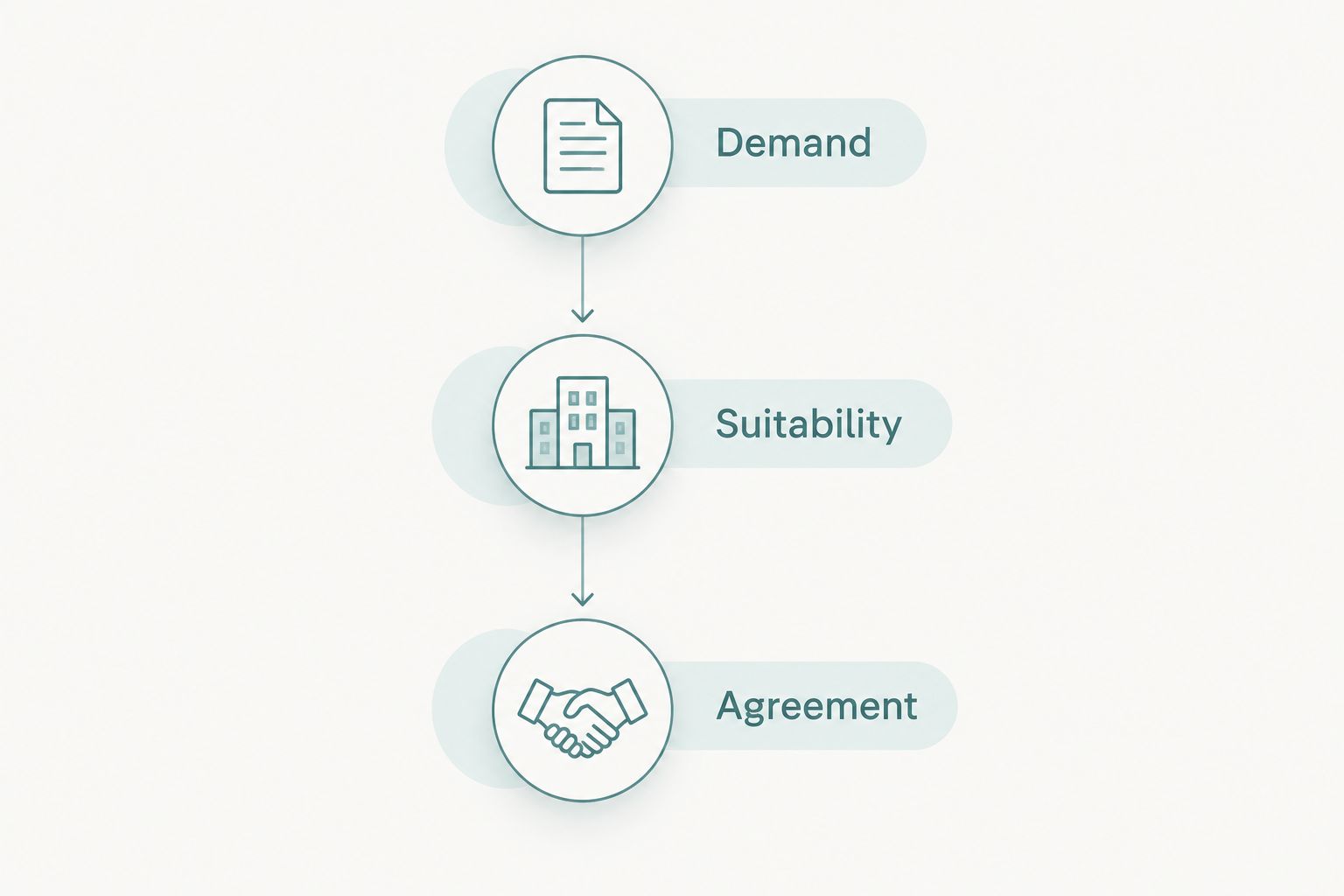
Use 3 decision gates before committing: demand, suitability and agreement. Each gate answers a different question. Keep the supporting information together so that an attractive building does not distract you from an unresolved service requirement.
Demand
Define 1 commissioning area for each shortlisted requirement. Record the operator, proposed service, acceptable locations and essential property features. Confirm whether discussions concern an exploratory search or a requirement ready for property assessment.
Suitability
Assess the address against the brief. Review access, layout, proposed occupancy and operational arrangements, then obtain appropriate advice on planning, licensing, fire safety and other applicable requirements. A property description is not a compliance assessment.
Agreement
Obtain 2 written confirmations before commitment: the operator’s property requirement and the agreed allocation of lease responsibilities. These do not replace professional advice or the lease itself. They give that review a defined starting point.
Diamond Property connects care agencies, supported living providers, NHS operators and other healthcare organisations with landlords and agents. Set out the location and property brief before discussing sourcing or lease negotiation.
Start with your property requirements
Discuss property sourcing and lease negotiation for a defined care-sector operating brief.
How we ranked the area profiles
The order follows the location criteria above: a defined operator requirement first, geographic expansion next, then specialist and building-led searches, followed by cross-border assessment. It ranks decision readiness, not investment returns.
No city-level return, occupancy or demand comparison supports a national winner here. Treat any claim that a named town is “best” as incomplete unless it identifies the service, local requirement and property assumptions behind that verdict.
Which supported living investment area should you choose?
Choose the operator’s confirmed service area as your default starting point. Move to a neighbouring area only when it has a separate brief. Let specialist requirements determine location when the service needs a particular building or setting.
For 2026, a disciplined shortlist is more useful than a long list of cities. Your next move is to document the operator requirement, reject unsuitable locations and assess the remaining properties against the same criteria.
FAQ
What are the best UK areas for supported living property investment in 2026?
The first shortlist is the area where a care operator has confirmed property requirements. Compare locations through the proposed service, property suitability and lease terms rather than assuming one UK city is best for every investment.
Is a neighbouring council area a good supported living investment location?
A neighbouring council area is an expansion option only when it has a separately confirmed operating requirement. Proximity to an existing service does not establish local demand or commissioning fit.
Should I buy a supported living property before finding an operator?
Establish the operator requirement before committing to the property. Without a defined brief, you cannot properly assess whether the location, layout and proposed use fit the intended service.
Does CQC registration mean a supported living property is approved?
No. CQC registration concerns regulated activities in England, not a blanket investment approval for a building. Assess the property's proposed use, permissions and suitability separately.
Is the cheapest town the best place to invest in supported living?
No. A property's suitability and required works matter alongside the financial commitment. An unsuitable building does not become suitable because its acquisition commitment is lower.
What does Diamond Property do for supported living operators?
Diamond Property provides property sourcing and lease negotiation for care-sector operators. It connects healthcare organisations with landlords and agents offering suitable properties on long-term company leases.
Does a long-term company lease remove landlord responsibilities?
No. Responsibilities depend on the agreement and applicable law, not simply the length of the lease. Obtain advice on repairs, adaptations, compliance obligations and reinstatement before signing.
One last thing
Ask for the property's rejection criteria before arranging viewings. An operator who needs a particular access arrangement or layout should identify that requirement at the start. It lets you reject the wrong building without confusing general residential appeal with supported living suitability.
Keep location approval and building approval separate. You need both before moving from a shortlist to a commitment.